AI and Workflow Automation in Manufacturing for Smarter Operations
A production delay rarely starts on the shop floor. It often begins much earlier, with a missing approval, a late material update, an unchecked quality issue, or a maintenance task that never reached the right team.
Manufacturing leaders know the pressure well. Customers want shorter lead times. Costs keep moving. Skilled labour is hard to retain. Supply chains remain sensitive to small disruptions. In this environment, operational efficiency is not a nice improvement. It is the difference between reliable output and constant firefighting.
This is where AI and workflow automation in manufacturing becomes a practical advantage. When systems talk to each other and routine decisions move faster, teams spend less time chasing updates and more time improving production.

Operational efficiency now decides manufacturing performance
Manufacturing has always measured performance through output, quality, cost, and delivery. What has changed is the speed at which these measures must improve.
A plant cannot rely only on monthly reviews or end-of-shift reports. By the time a delay appears in a report, the impact may already be visible in missed dispatch timelines, overtime costs, rework, or customer escalations.
Operational efficiency now depends on three connected capabilities:
Visibility
Teams need a live view of production, materials, quality, and maintenance conditions.
Speed
Decisions must move quickly across departments without waiting for manual follow-ups.
Coordination
Planning, procurement, production, quality, stores, dispatch, and service teams need to work from the same operational picture.
When these capabilities are weak, even a strong production team struggles. A machine may be available, but material may not be issued. Material may be ready, but quality clearance may be pending. Quality may approve the batch, but dispatch may not receive the update in time.
Efficiency suffers when each function performs well on its own but fails to connect with the next function.
Why disconnected systems create hidden losses
Many manufacturers have invested in ERP systems, production planning tools, spreadsheets, machine data systems, and messaging apps. The issue is not always the absence of technology. More often, it is the absence of connection.
A typical manufacturing workflow may include:
Production plans in one system
Maintenance records in another
Quality checks on paper or spreadsheets
Purchase updates shared through calls or messages
Approval trails buried in email
Inventory adjustments entered after a delay
Customer commitments tracked by sales separately
Each of these systems may serve a purpose. The problem appears when no single workflow connects the full chain.
Consider a common example. A planner schedules a batch for the morning shift. The machine is available, but a critical tool requires maintenance. Maintenance knows about the issue, but the planner does not. Stores has a substitute tool, but it needs quality approval before use. The quality team has not received a request. The shift starts, operators wait, and the schedule slips.
No one intended to cause a delay. The delay came from broken handoffs.
Manual processes add another layer of risk. Paper checklists, phone-based approvals, and spreadsheet trackers depend heavily on memory and follow-up. They may work at small scale, but they become fragile as product lines, suppliers, and customer requirements grow.
The result is familiar:
Disconnected operation | Business impact |
Delayed approval for production changes | Longer cycle time and missed schedules |
Manual quality reporting | Late detection of defects and more rework |
Poor maintenance visibility | Higher unplanned downtime |
Inventory data entered late | Material shortages or excess stock |
Isolated dispatch updates | Customer communication gaps |
These losses often remain hidden because they appear as “normal delays”. Over time, they reduce margins, weaken delivery reliability, and make improvement efforts harder to measure.

How AI changes manufacturing decisions
AI in manufacturing is valuable when it helps teams see problems earlier, decide faster, and act with better context. It does not replace process discipline. It strengthens it.
In practical terms, AI can support manufacturing operations in several ways.
It detects patterns humans may miss
Production data often contains weak signals. A machine may show a small change in vibration, temperature, power use, or rejection rate before a breakdown. A human may not notice the pattern in time, especially across multiple machines and shifts.
AI models can study historical and live data to identify unusual behaviour. This helps maintenance teams move from reactive repairs to planned interventions.
For example, a component manufacturer may use machine sensor data to flag a spindle that is likely to need attention. Instead of waiting for failure during a high-priority job, maintenance can schedule inspection during a planned break.
It improves planning accuracy
Demand variation, supplier delays, machine constraints, and labour availability make production planning difficult. AI can help compare many factors and suggest schedules that reduce idle time or bottlenecks.
For example, if one product requires a special process with limited machine capacity, AI can help planners see the effect of running that product before or after another job. The system can also highlight material risks before the plan is released.
This does not remove the planner from the process. It gives the planner a stronger starting point and clearer trade-offs.
It strengthens quality control
AI-based visual inspection can support quality teams by checking surface defects, missing components, incorrect assembly, label errors, or dimensional issues. This is useful in high-volume environments where manual inspection can become inconsistent.
A packaging line, for example, can use camera-based inspection to detect incorrect labels before products reach dispatch. A fabricated parts unit can use image analysis to flag visible defects for human review.
The best results come when AI inspection connects with workflow actions. A defect should not only generate a report. It should trigger containment, notify the correct team, update batch status, and start root cause analysis.
Workflow automation turns decisions into action
AI helps identify what is happening. Workflow automation helps ensure the right action happens next.
Manufacturing workflow automation connects tasks, approvals, alerts, and records across departments. It reduces dependence on manual chasing and creates a clear process trail.
A strong automated workflow answers four questions:
What happened?
Who needs to act?
What is the deadline?
What happens if the task is delayed?
This is especially useful in areas where coordination matters more than individual speed.
Example 1. Maintenance and production coordination
Without automation, a maintenance request may stay in a register or message thread until someone follows up. With an automated workflow, an operator can raise a machine issue from a terminal or mobile device. The system can assign the task, notify maintenance, update the planner, and mark the machine status.
If the issue affects a scheduled order, the planning team sees the impact earlier. They can shift jobs, inform stores, or adjust dispatch expectations before the delay spreads.
Example 2. Quality non-conformance management
When a defect appears, speed matters. The batch may need to be held, inspected, reworked, or rejected. A manual workflow can lose time between detection, review, approval, and corrective action.
An automated non-conformance workflow can:
Capture defect details with photos or inspection values
Hold affected inventory
Notify production, quality, and planning
Assign root cause analysis
Track corrective and preventive action
Record final disposition
This creates accountability and reduces the chance of defective material moving forward by accident.
Example 3. Procurement and stores alignment
Procurement delays often affect production quietly until the shortage becomes urgent. Automated workflows can connect purchase orders, supplier updates, goods receipt, inspection status, and material issue.
If a critical item is delayed, the system can alert planning before the shortage stops production. If material arrives but awaits inspection, quality receives the task automatically. Once cleared, stores can issue it against the correct work order.

The real value lies in connected functions
A single automated workflow can improve one process. A connected operating model can improve the whole plant.
Manufacturing depends on handoffs. Planning hands work to production. Production depends on stores. Stores depends on procurement and quality. Quality affects dispatch. Maintenance affects every production promise. Finance may need cost and consumption data. Management needs accurate performance visibility.
When these functions operate in isolation, delays multiply. When they share data and workflows, the plant becomes easier to manage.
Connected functions help manufacturers:
Reduce waiting time between departments
Prevent duplicate data entry
Improve schedule adherence
Catch quality issues earlier
Make maintenance more predictable
Improve material availability
Give leaders a live view of constraints
Build a stronger audit trail
The key point is simple. A smart factory is not only about smarter machines. It is also about smarter coordination.
A machine can produce at high speed, but if the approval workflow is slow, the order still waits. A planner can create a good schedule, but if inventory updates are late, the schedule still fails. A quality team can detect defects, but if containment does not happen quickly, the cost still grows.
Where the OLIM Platform fits into digital transformation
For manufacturers, digital transformation should not feel like a large technology project with unclear results. It should solve daily operating problems, one workflow at a time, while building a connected foundation for future growth.
The OLIM Platform is significant in this context because it supports the move from scattered processes to connected operations. A platform-led approach can bring workflows, task ownership, process visibility, and cross-functional coordination into one operating environment.
Rather than treating automation as separate tools for separate teams, OLIM can help manufacturers build a shared digital layer across operational functions. This matters because the benefit of automation rises when production, quality, maintenance, stores, procurement, and planning work from connected information.
A platform such as OLIM can support digital transformation by helping manufacturers:
Map key operating workflows
Set clear responsibility for each step
Track approvals and escalations
Connect operational data with daily actions
Create visibility across departments
Reduce manual follow-up
Standardise repeatable processes
Build a record of decisions and actions
For Indian manufacturers working across multiple plants, suppliers, and customer requirements, this connected approach can be especially useful. It supports consistency without removing local operating knowledge. Plant teams still make decisions, but they do so with clearer data and faster coordination.
The practical value is not only in digitising a checklist. It is in making sure the checklist triggers the next step, reaches the right person, and updates the wider operation.
What smarter manufacturing operations look like
Smarter operations are not defined by the number of dashboards on a screen. They show up in daily work.
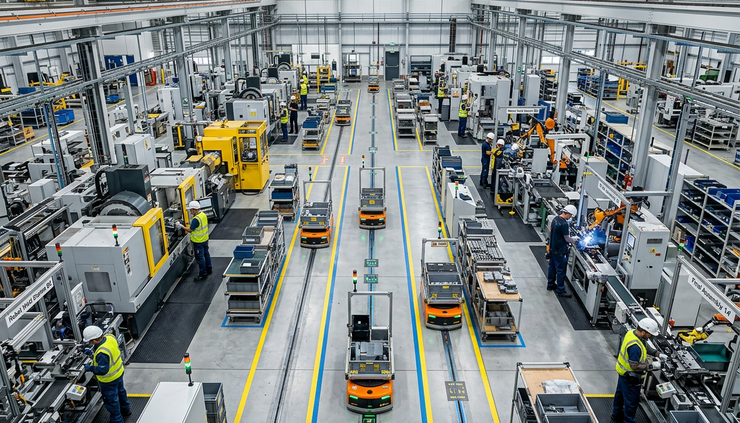
A supervisor starts a shift with a clear view of machine status, material readiness, pending quality holds, and priority jobs. A planner sees which orders are at risk before the customer asks for an update. A maintenance team receives early warnings and planned tasks instead of only emergency calls. A quality manager can trace defects to batches, machines, shifts, or suppliers more easily. Stores can issue materials based on live demand rather than last-minute pressure.
This is how AI and automation create value. They reduce uncertainty.
Here is what the shift can look like before and after connected automation:
Before connected workflows | After connected workflows |
Teams chase updates through calls and messages | Tasks and alerts move through defined workflows |
Defects are recorded after the event | Quality issues trigger immediate containment |
Maintenance reacts to breakdowns | Maintenance acts on early warning signs |
Planning works with delayed inventory data | Planning sees material and machine constraints sooner |
Managers review problems late | Managers see live exceptions and pending actions |
The goal is not to remove human judgement. Manufacturing still needs experienced operators, planners, engineers, and supervisors. The goal is to remove avoidable friction so their judgement reaches the right place faster.
How manufacturers can begin without overwhelming the plant
A practical starting point is to focus on workflows that create frequent delays or high costs. Manufacturers do not need to automate everything at once.
Good first candidates often include:
Machine breakdown reporting
Preventive maintenance scheduling
Quality non-conformance workflows
Production change approvals
Material shortage alerts
Goods receipt and inspection
Dispatch readiness checks
Corrective action tracking
Start with one process where the pain is visible. Map the current steps. Identify delays, duplicate entries, and unclear ownership. Then design a workflow that assigns tasks, sets timelines, captures evidence, and alerts the next function.
After the first workflow proves useful, connect it with related functions. For example, a maintenance workflow can connect with planning. A quality hold workflow can connect with stores and dispatch. A material shortage workflow can connect with procurement and production planning.
This staged approach builds trust. Teams see value in their daily work, not just in management reports.
The takeaway for manufacturing leaders
Operational efficiency now depends on connection as much as capacity. Machines, materials, people, and decisions must move together. When workflows remain manual and systems stay disconnected, delays become normal and improvement becomes harder to sustain.
AI helps manufacturers detect patterns, improve planning, and identify risks earlier. Workflow automation ensures those signals turn into clear action. Platforms like OLIM bring these capabilities into a connected operating model, helping manufacturers move from reactive coordination to smarter, more reliable execution.
Smarter operations do not happen by adding technology on top of broken handoffs. They happen when every critical function can see, act, and respond as part of the same manufacturing flow.


Comments